Yohana
Embedded with a startup, working at the altitude where POV and customer journey get built.
For three and a half years, I worked as an embedded writer and creative partner at Yohana, a Panasonic-backed personal assistant service designed to ease parental burnout. The work spanned the customer lifecycle — from the campaign editorial strategy that defined each quarter to the in-app copy members used every day. The brand didn't survive; the thinking did.
PROJECT DETAILS
✳︎ ROLE: Embedded writer & creative partner
✳︎ TENURE: November 2021 to March 2025
✳︎ SCOPE: Campaign editorial strategy, productized offers, brand voice, lifecycle copy (acquisition, onboarding, engagement), national launch, app, OOH
✳︎ TEAM: Embedded in an in-house creative team alongside Head of Creative Aaron Brown, CD Vicky Montero, AD Madi Barbier, Lead Designer Kelsey Sutherland, UX and Motion Designer Vlad Diedov, and fellow writers Darrah MacLean, Rowena Ritchie, and Allison Ford. We worked closely with cross-functional partners in Marketing, Operations, and Engineering.
✳︎ CONTEXT: During my tenure, Yohana achieved 50% client growth and 13% CSAT increase across a period that included the new product catalog, growth marketing investment, and the national launch.
Surviving
→
Thriving
Surviving → Thriving
THE CLIENT
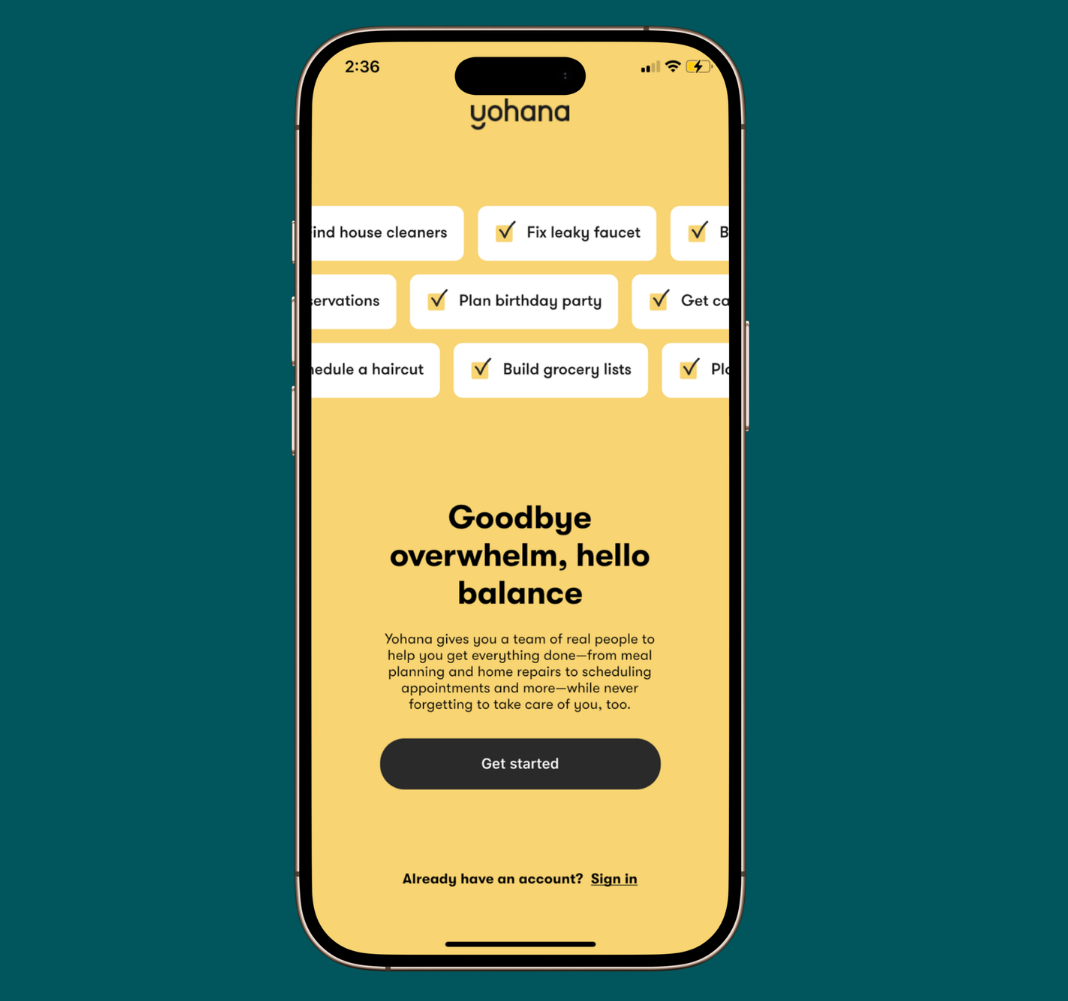
Founded in 2019, Yohana, a fully owned subsidiary of Panasonic, was a personal assistant service for busy families. Staffed by real people and mediated by an app, Yohana was designed to ease parental burnout by helping members tackle their neverending to-do lists. The service promised to help members with pretty much anything they could think of.
Apart from a handful of super users, most members in the Seattle pilot group weren't engaging consistently — they didn't know what to ask for, or even how to delegate. Operationally, the open-endedness was also unworkable at scale. As we approached the national rollout, the creative problem sharpened: how do you make an unbounded service feel graspable, usable, and worth paying for?
THE PROBLEM
THE WORK
From the first ad a parent saw to the monthly nudge that kept them subscribed, the work spanned the entire customer lifecycle — the manifesto that opened each quarter, the in-app offer copy that made members sigh in relief (and then press "Add to-do"), the onboarding sequence that taught new members how to actually use what they'd bought, the ongoing education that encouraged them to dream bigger once their most pressing needs had been met. The question underneath every piece was the same: what can we do in this moment to move parents away from survival mode and closer to thriving?
THE FIX
To make Yohana work — for parents and as a business — we needed to give them three things: permission, education, and ease. First, they needed to know that it was okay to ask for help, that delegation is a skill, not an indulgence. Our job wasn’t simply to push people through a funnel; it was to shift a cultural narrative centered on individualism and self-sufficiency. Next, parents had no model for delegating inside their own families; they needed coaching on what to hand off first. And since using Yohana should relieve parents’ mental load, not add to it, the experience had to be effortless — which meant working alongside Marketing, Operations, and Engineering to make handing off a task feel as simple as ordering takeout.
THE CODA
Ultimately, Yohana didn't survive as a business — Panasonic wound the brand down in 2025 as it shifted toward its next-generation product. The creative thinking was sound; whether a brand's conditions let good thinking become a good outcome is a separate question, and that's the most useful thing I learned here.
I co-developed a year-long campaign editorial strategy that connected Yohana's new seasonal offers to a single point of view about how the brand could help parents thrive, not just in the short term, but over the entire course of their membership. The architecture included four quarterly concepts — Reframe, Refresh, Rebalance, Reflect — each mapped to a stage of Maslow's hierarchy of needs and to the emotional reality of how parents move through a year. I wrote the manifestos for each quarter.
The overarching narrative never got exec sign-off, but the seasonal concepts and the offers they generated did, directly shaping the productized catalog the Ops team rolled out in 2023.
Strategy co-developed with Head of Creative Aaron Brown, CD Vicky Montero, AD Madi Barbier, Lead Designer Kelsey Sutherland, CW Darrah MacLean, and Marketing partners Danielle Mau and Ricky Eggers.
CAMPAIGN EDITORIAL STRATEGY
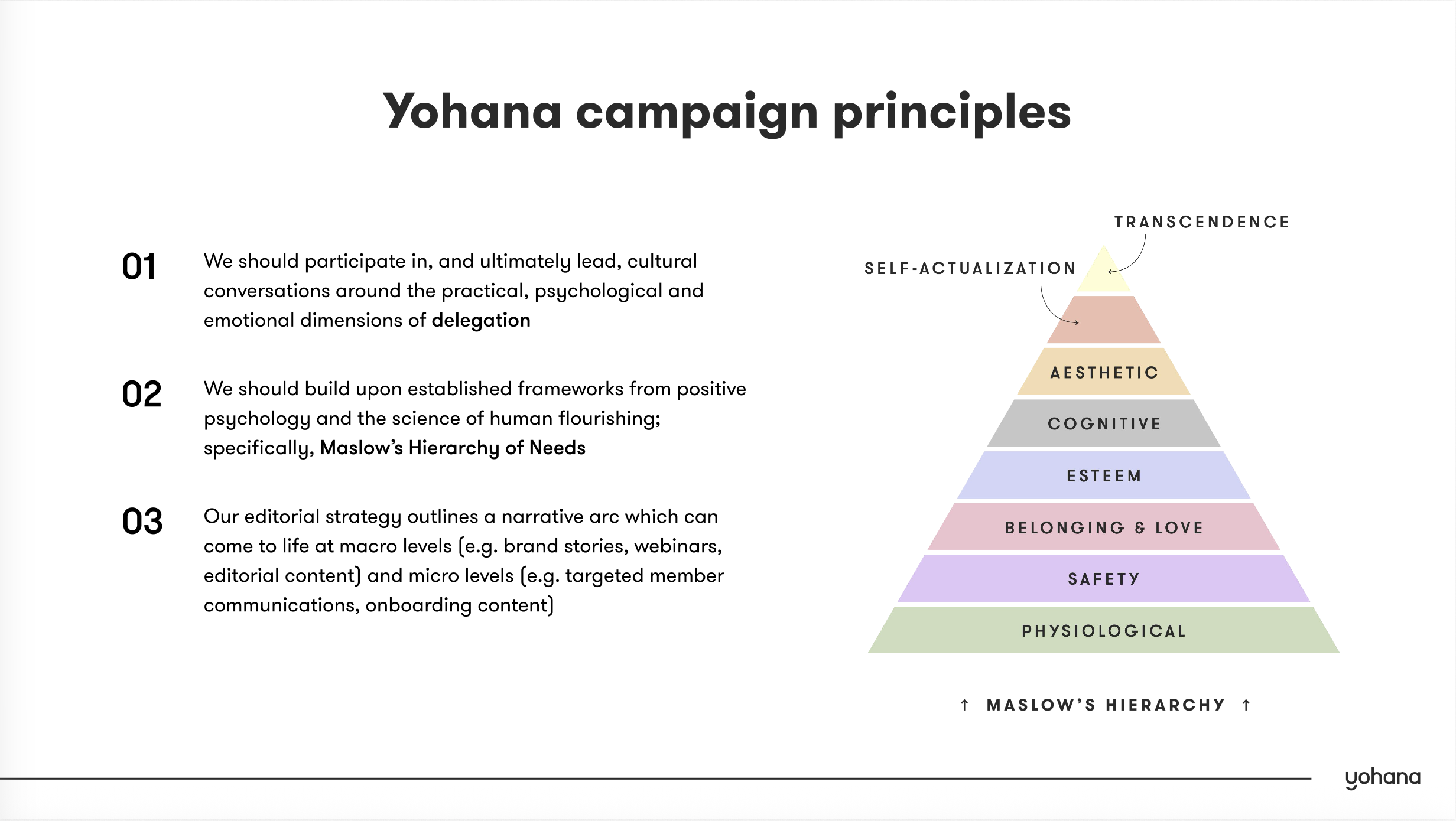
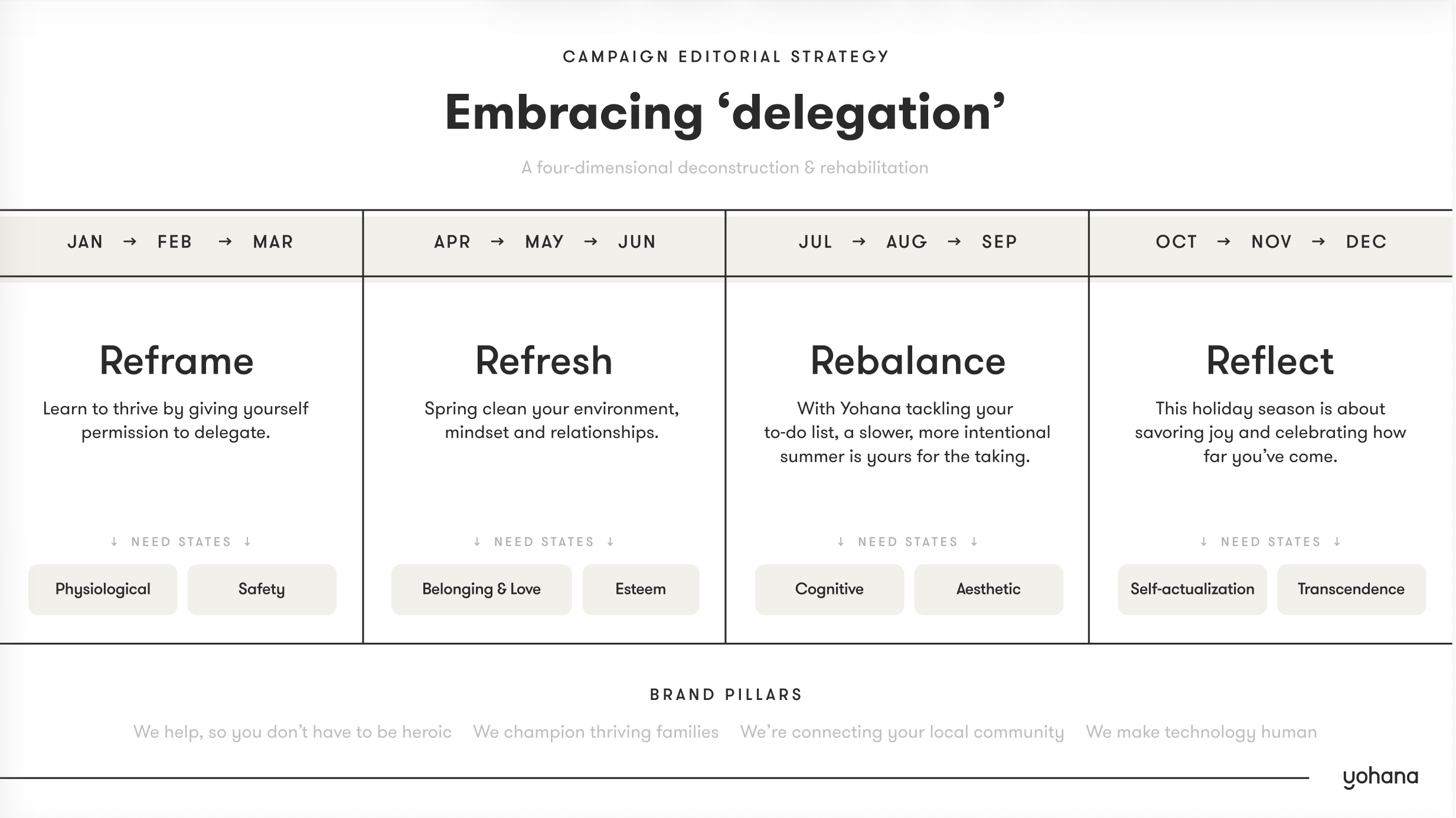
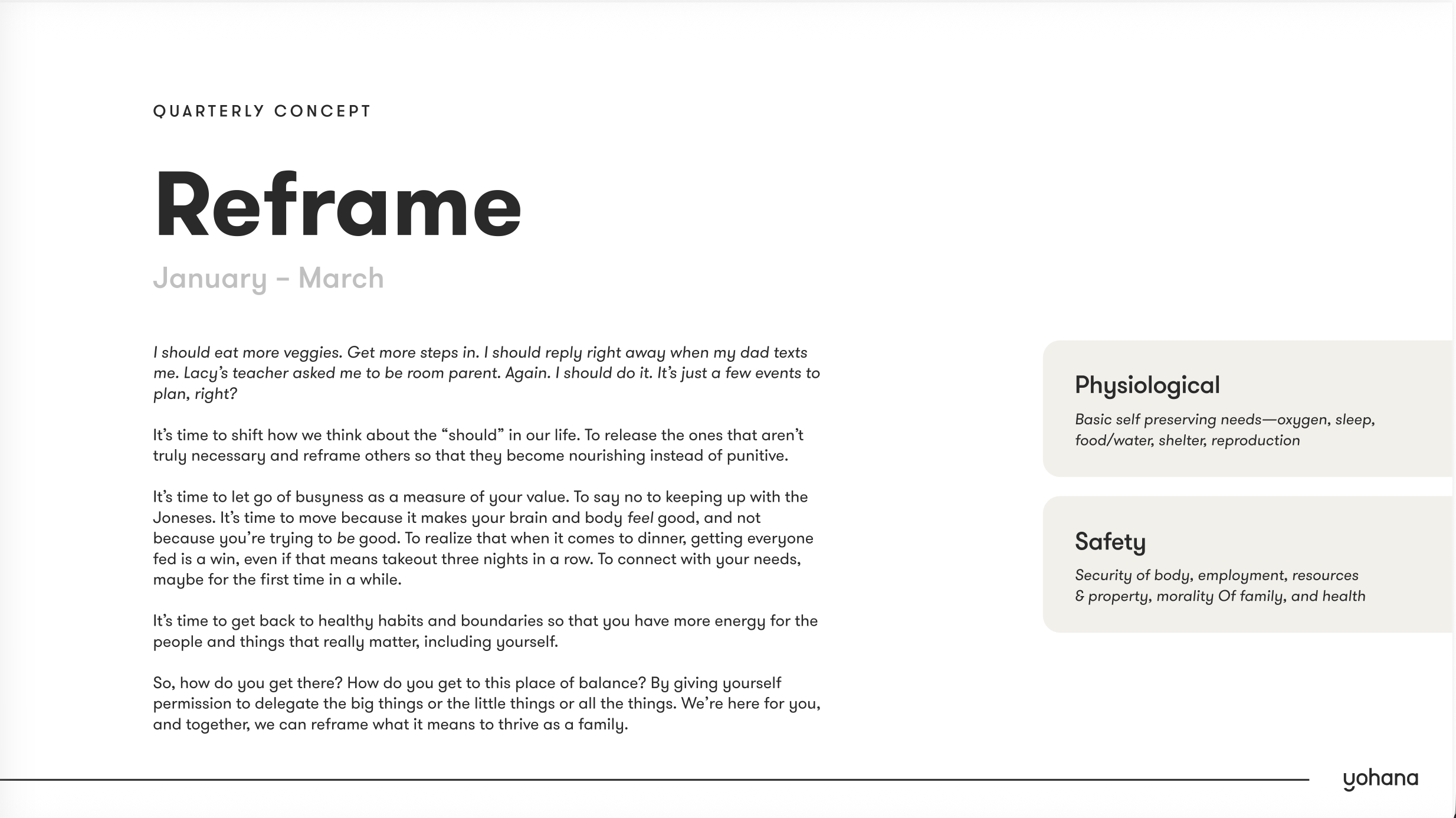
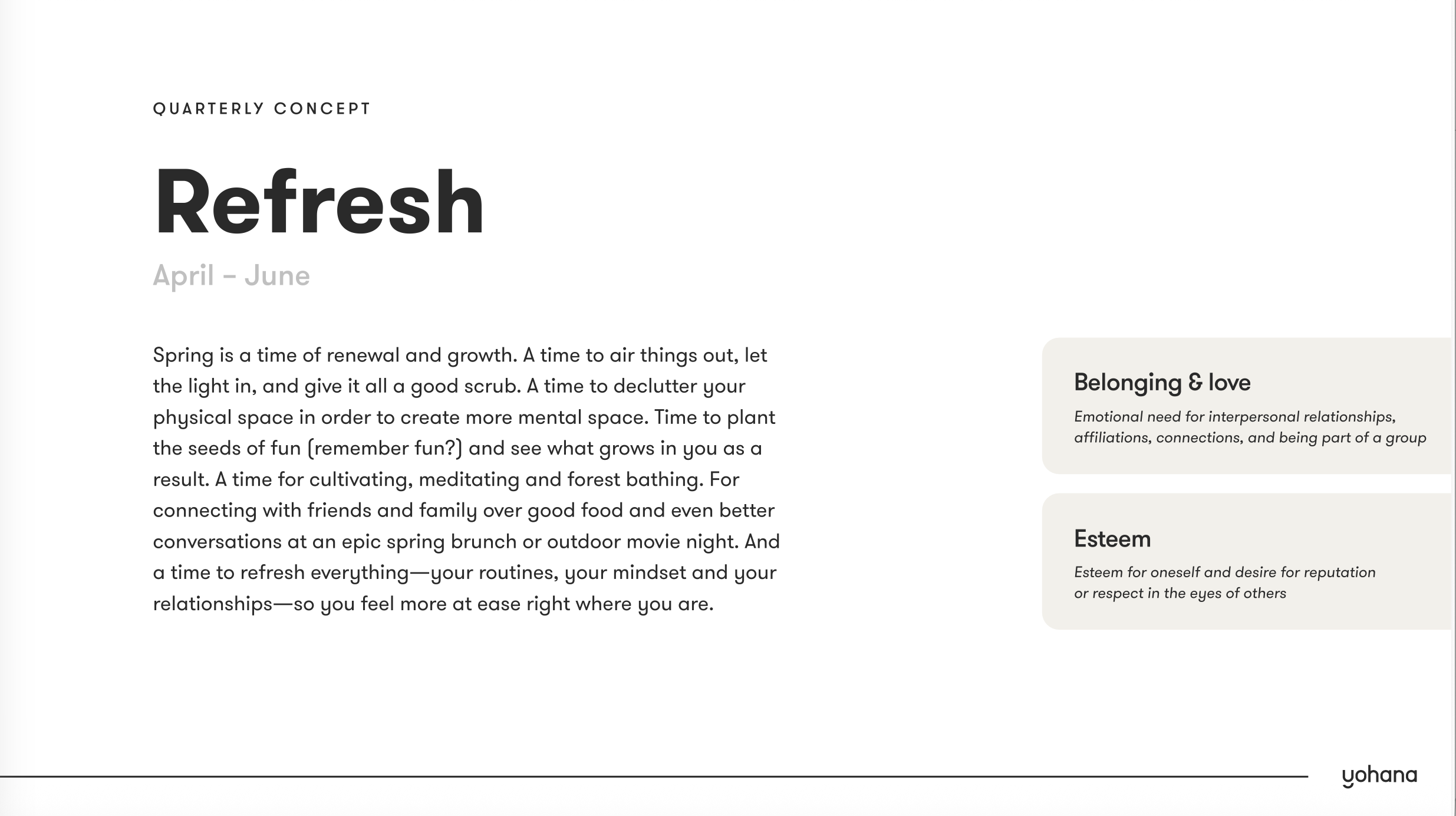
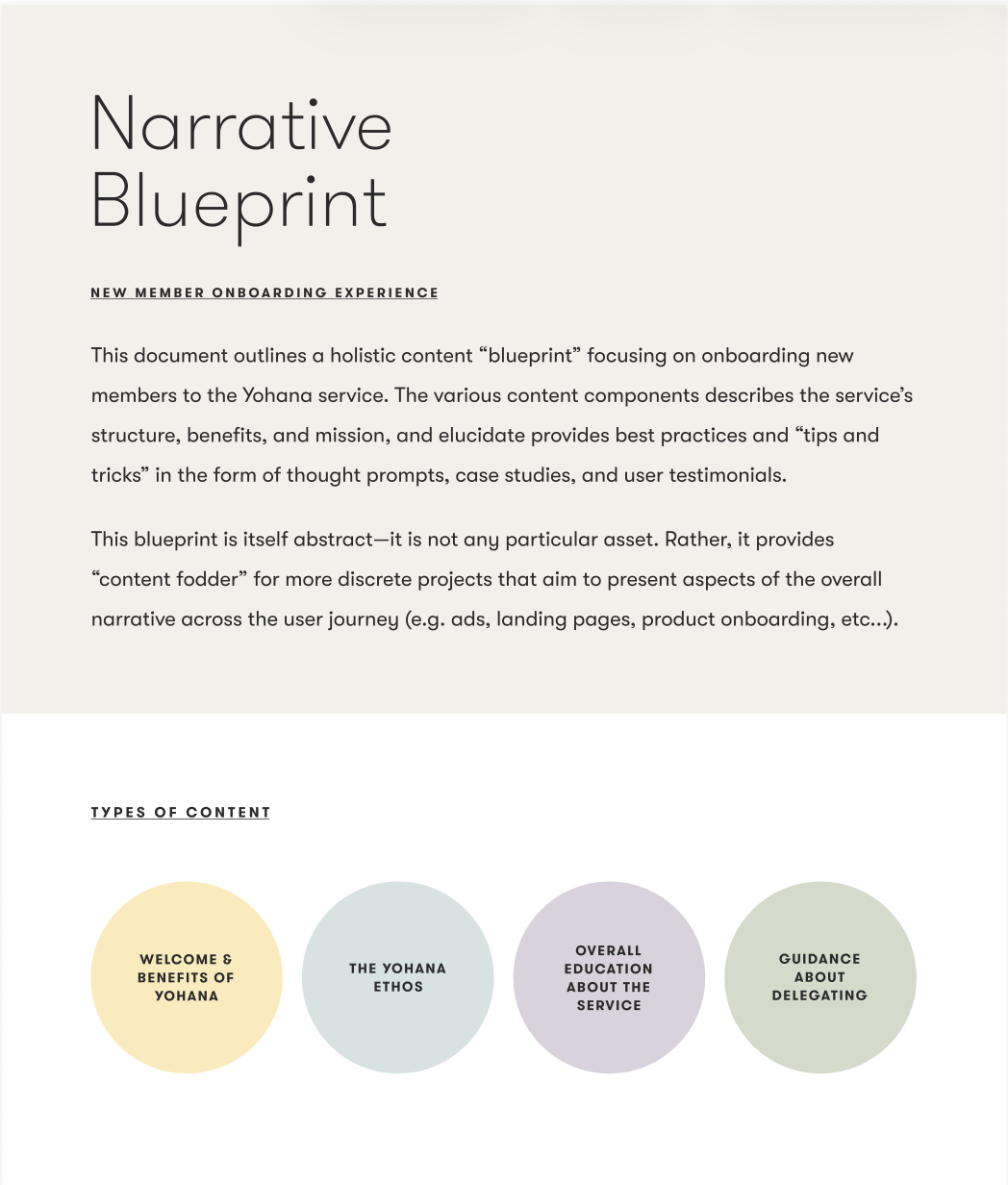
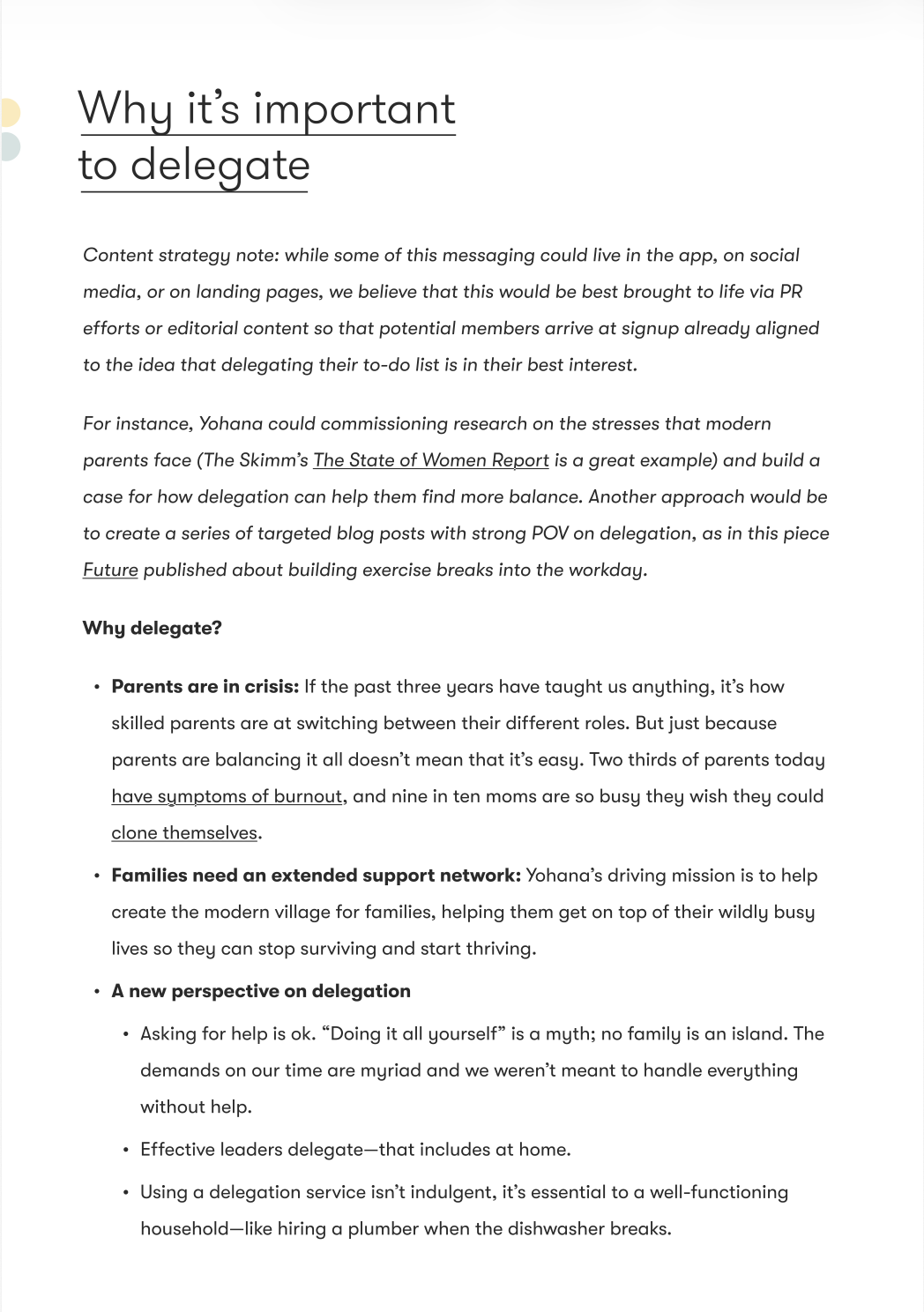
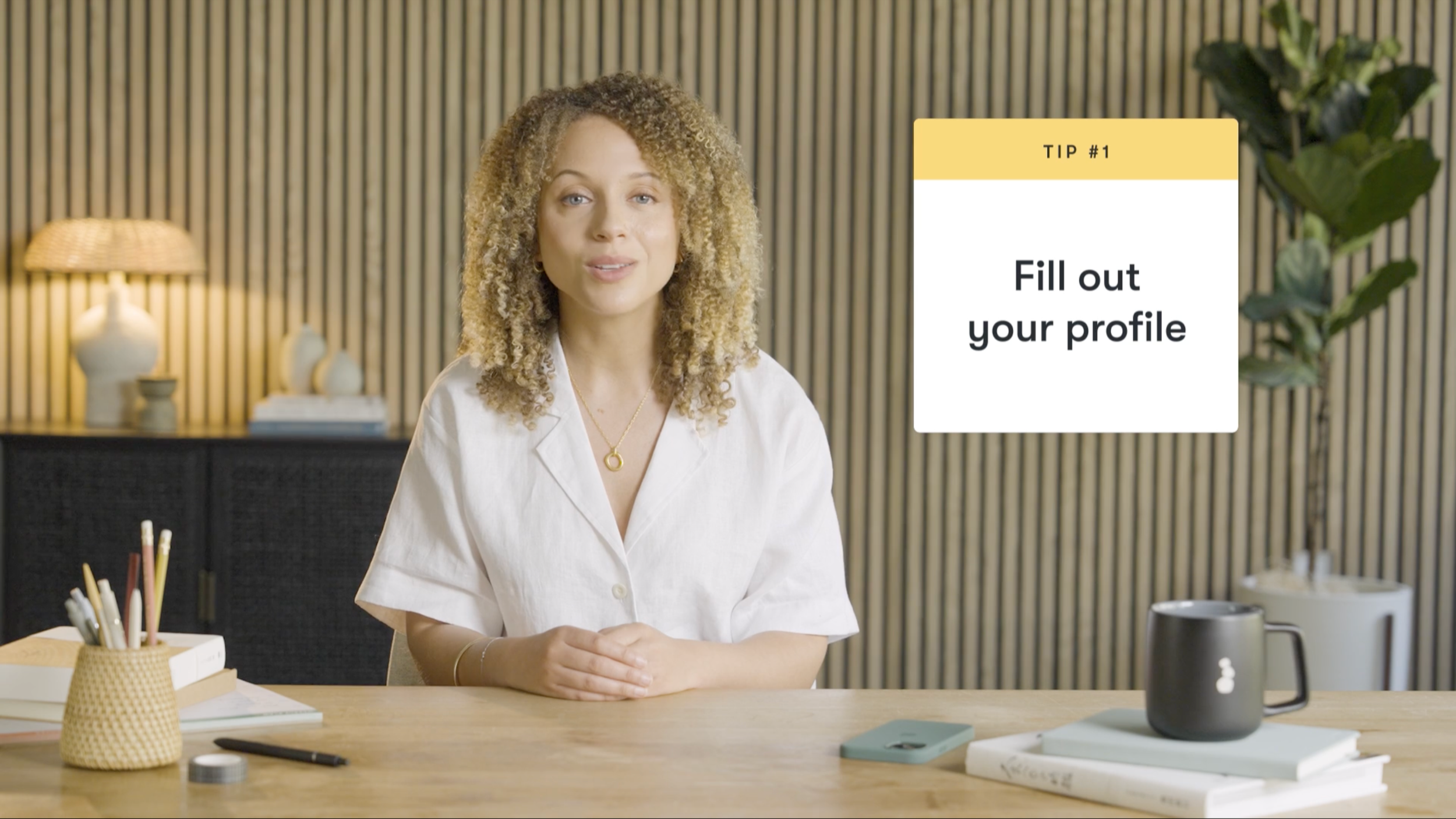
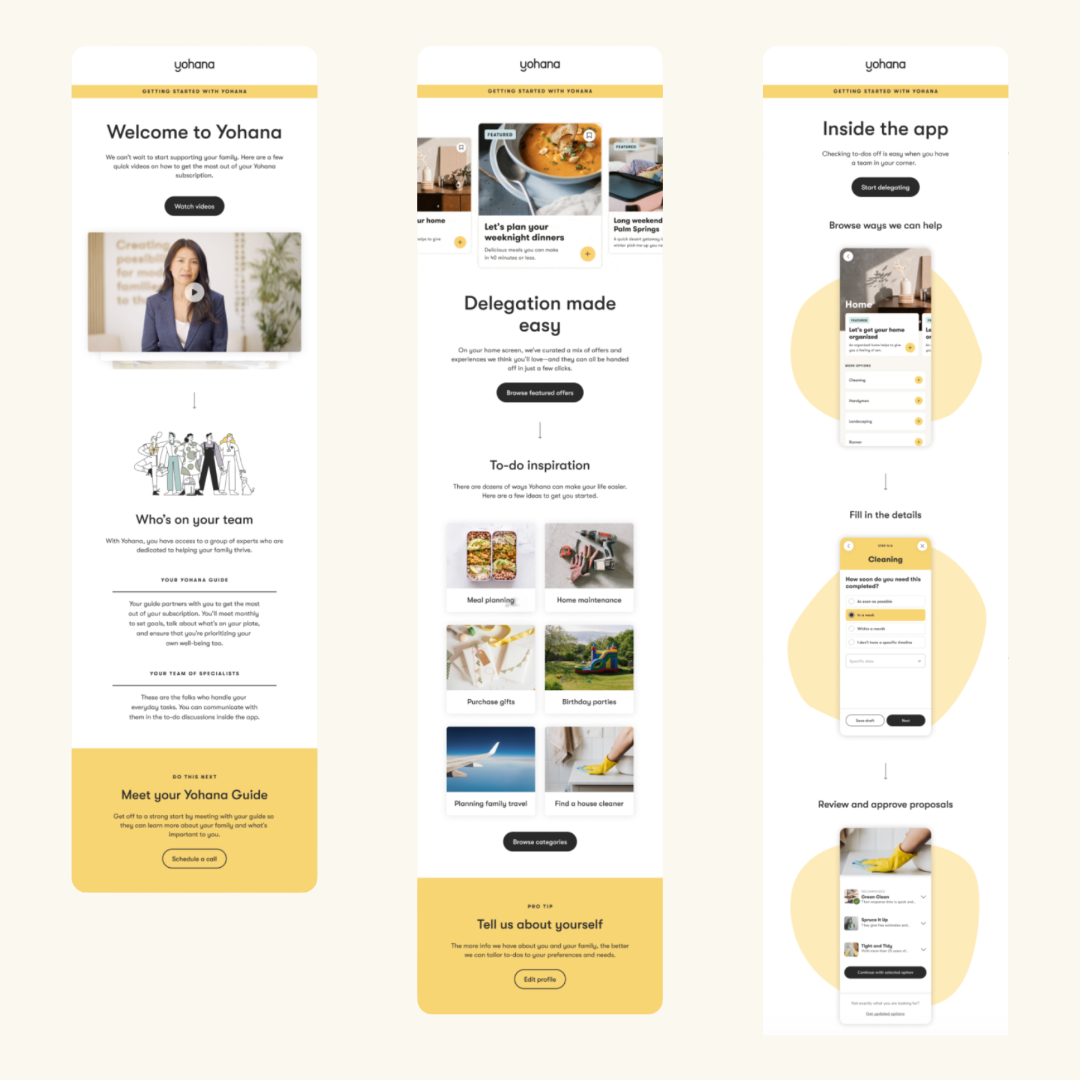
Members weren't engaging because they didn't know how to use the service, a problem that had to be solved before purchase, not after. We needed them to arrive aligned to the idea that delegating was in their best interests — with concrete ideas about what to hand off and why — which meant seeding the narrative prior to purchase. I co-authored the narrative blueprint that outlined how we would educate parents about delegation, from the ads parents saw before they ever heard the word “Yohana” through to the post-purchase emails and explainer videos that taught them how to use the service. The team recommended seeding the narrative upstream via PR and editorial; in practice, the messaging mostly lived inside the product, which still gave new members a coherent roadmap for what they'd bought and how to use it.
Blueprint co-developed with Head of Creative Aaron Brown, CD Vicky Montero, and AD Madi Barbier.
ONBOARDING AND LIFECYCLE ARCHITECTURE
PRODUCTIZED OFFERS
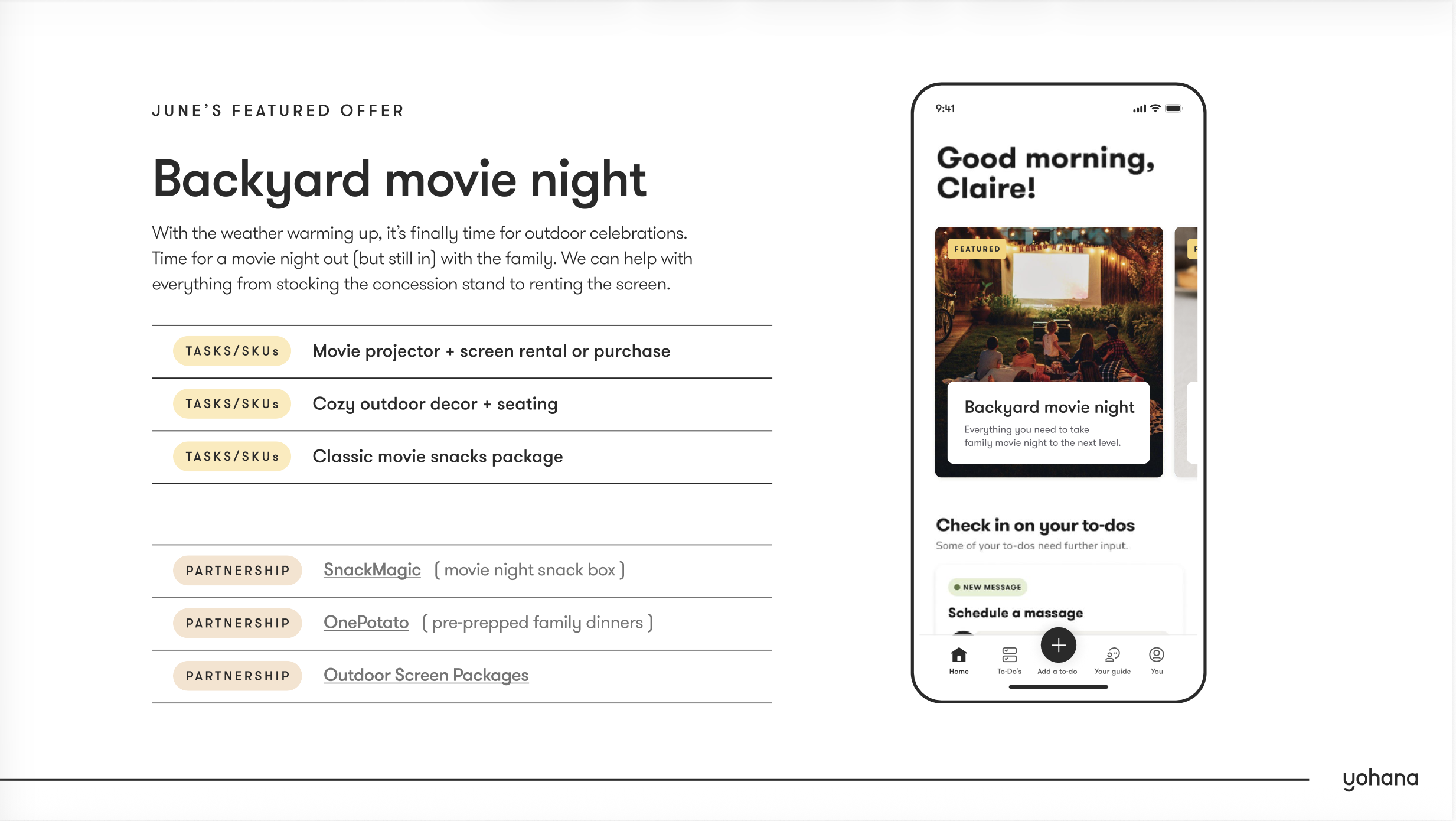
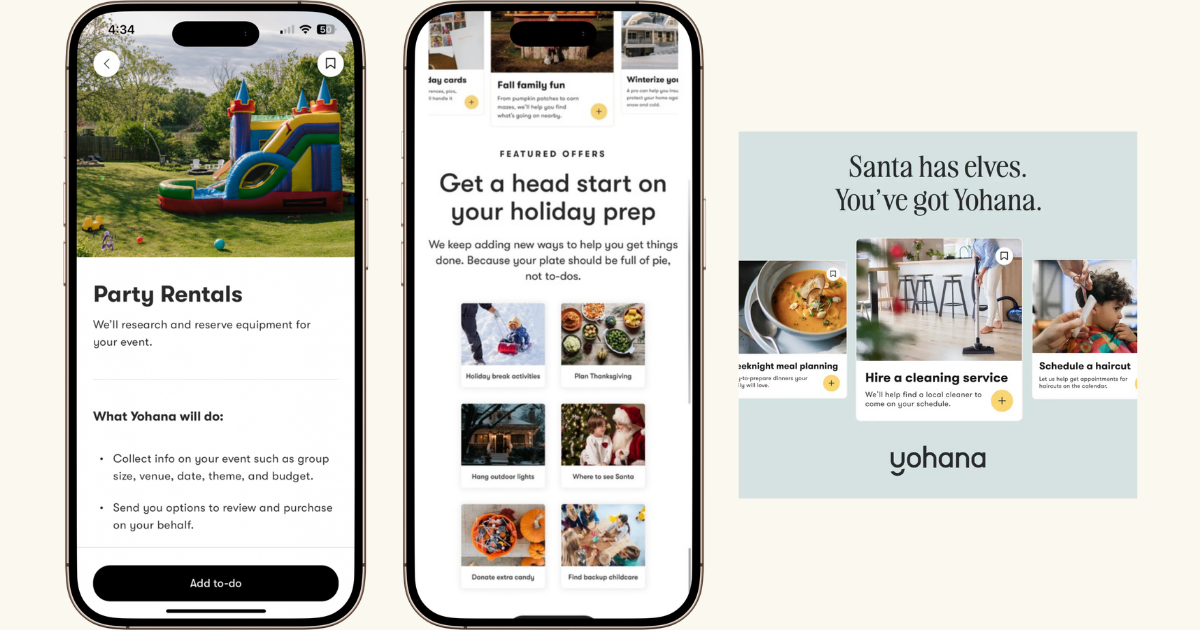
Members didn't know what to ask for. Ops didn’t have a playbook to execute against. Productized to-dos solved both problems. Our challenge: making these new offers feel desirable, easy to opt into, and human, never transactional. Each offer I wrote was a miniature service pitch in the brand's voice — specific enough to be usable, warm enough to feel like a helping hand instead of an SKU.
Strategy co-developed with Head of Creative Aaron Brown, CD Vicky Montero, AD Madi Barbier, Lead Designer Kelsey Sutherland, CW Darrah McLean, and Marketing partners Danielle Mau and Ricky Eggers.